


Specialist Care Coordination for One Complex Condition.

Principal Care Management is a CMS program that reimburses practices for managing a single serious chronic condition between office visits, where that condition needs specialist direction rather than general coordination. CareNexa's clinical team runs that management on your behalf and bills it correctly, every month.

Eligibility Criteria

01.

One complex chronic condition expected to last at least three months, requiring disease specific management rather than general care coordination

02.

The condition places the patient at significant risk of hospitalization, acute exacerbation or decompensation, or functional decline

03.

Patient has provided informed consent to enroll (verbal consent is generally acceptable but must be documented; written consent is recommended)

04.

A disease specific care plan is established, implemented, revised or monitored as part of enrollment

Full CPT Code Breakdown

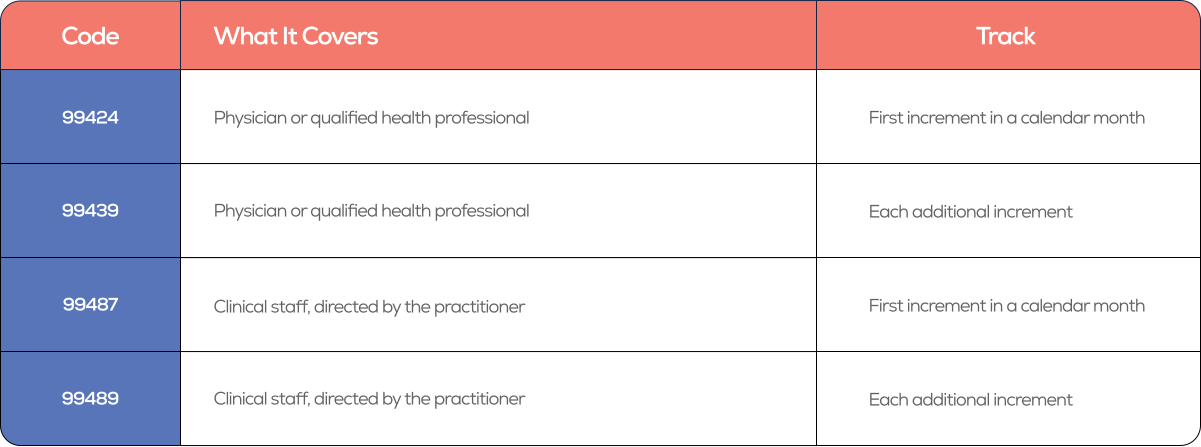
Every PCM code is defined by minutes of time per calendar month, split between practitioner time and clinical staff time. CareNexa’s coordinators log that time as the work happens rather than reconstructing it at month end. Your practice bills what was actually delivered, with the documentation already attached.

Patient eligibility

One complex chronic condition expected to last at least three months, serious enough to place the patient at risk of hospitalization, acute exacerbation or functional decline, and requiring a disease specific care plan that a specialist is best placed to direct. Unlike chronic care management, a second qualifying condition is not required, which is what makes this the specialist’s program.

What is included:

  • Monthly care management contact built around the one condition
  • Disease specific care plan creation and revision 
  • CPT qualification tracking and audit ready documentation 
  • Billing under the PCM codes 
  • Zero device or setup cost to the practice 

Conditions that commonly qualify 

  1. Rheumatoid arthritis, lupus, psoriatic arthritis, ankylosing spondylitis, vasculitis and other inflammatory disease on systemic or biologic therapy.
  2. Heart failure under active management, including the ninety days after a cardiac admission. 
  3. Chronic kidney disease approaching a modality decision. 
  4. COPD with an exacerbation history.
  5. Poorly controlled type 1 diabetes or insulin treated type 2 diabetes mid titration.
  6. Epilepsy, multiple sclerosis and Parkinson’s disease under specialist management. 
  7. Chronic wounds where the underlying condition drives the outcome.

Sample Patient Journey — Month to Month

Enrollment is not the finish line; it is the start of a recurring monthly rhythm. Here is what a typical CareNexa PCM patient experiences from identification through ongoing care. 

Month 0

Patient is identified from your panel as having one condition dominant enough to qualify, contacted, and enrolled with documented consent. We check who else is billing care management for that patient before anyone is enrolled. 

Month 1

A disease specific care plan is built covering the condition, the medication regimen, the monitoring obligations attached to the therapy, goals and care team contacts, then shared back to the practice.

Months 2+

Monthly touchpoint covers adherence, disease activity, laboratory and monitoring compliance, and care plan updates; time is logged and billed under the appropriate PCM code. 

As needed

Any concerning finding is escalated to the practice per the agreed protocol. Where the condition stabilizes, or a second qualifying condition becomes significant, we tell you, because that changes which program the patient belongs in.

The Revenue Math, Shown Transparently

Enrolled Patients
Per month, low 
Per month, high
Per year, low
Per year, high
50
50 x low rate 
50 x high rate 
x 12 
x 12 
100
100 x low rate 
100 x high rate 
x 12 
x 12 
150
150 x low rate 
150 x high rate 
x 12 
x 12 

The number that bills 

Enrolled and sustaining are different figures, and only the second produces revenue. PCM carries one variable chronic care management does not. A patient whose second chronic condition becomes significant moves to the CCM program and stops billing on this line. That is the right clinical outcome and it is a reduction here, which is why we show the method rather than a single headline.

Principal Care Management Specific FAQ

How is this different from chronic care management?

Chronic care management needs two or more chronic conditions and coordinates across all of them. Principal care management needs one, and the work goes deep on that condition rather than broad across several. The care plan is disease specific, the monthly contact is built around the therapy and its monitoring obligations, and the codes are a different family. In practice it is the specialist’s version of the same idea. 

This is close to the reason the program exists. A specialist managing the one condition that dominates a patient’s care has, until now, had no way to be paid for the work between visits when the primary care physician holds the care management relationship. We verify the specific combination for each patient with your billing lead before enrollment rather than assuming it, because the single biller rules differ by program and by period. 

Done correctly, structured PCM documentation is more defensible than ad hoc specialist follow up, because every billed minute is timestamped and tied to a specific coded activity against a care plan. The failure mode CMS penalizes is under documented time, which is the specific thing this workflow is built to prevent. We would rather bill less than bill something we cannot evidence. 

They may belong in chronic care management instead, and we raise it rather than leaving the patient in the program that is easier to keep billing. The care plan carries over, the contact rhythm does not change from the patient’s side, and your billing lead confirms the switch before it happens. 

The ones where a single condition is severe enough to organize everything else around it. Rheumatology on biologic therapy, advanced heart failure, chronic kidney disease approaching dialysis, poorly controlled diabetes and neurology under active titration are the clearest fits. Where a patient carries several conditions that genuinely compete, chronic care management is the better program and we will say so. 

One Condition Is Often Enough to Justify Monitoring

A patient whose single condition is serious enough for principal care management frequently has a measurement worth taking between visits. Running monitoring alongside it means the disease specific management time and the monitoring time are tracked and billed separately, through one clinical team and one dashboard, instead of two disconnected programs.