


Structured Behavioral Health Care Inside Your Primary Care Practice.

Behavioral Health Integration and Collaborative Care Management are CMS programs that reimburse practices for the behavioral health work happening between appointments. Validated screening, structured follow up, symptom tracking against a baseline score, and psychiatric input where the model calls for it. BHI suits primary care and psychiatry alike. Collaborative care needs a primary care team. CareNexa runs both and bills them correctly, every month.

Eligibility Criteria

01.

A behavioral health condition diagnosed by the treating clinician, whether that clinician sits in primary care or psychiatry

02.

The patient needs structured follow up between visits, whether for symptom monitoring, medication response or engagement

03.

Patient has provided informed consent to enroll (verbal consent is generally acceptable but must be documented; written consent is recommended)

04.

For collaborative care specifically, a primary care team is in place: the treating provider, a behavioral health care manager and a psychiatric consultant, with systematic follow up and a patient registry

BHI or Collaborative Care:
Which One You Can Actually Run

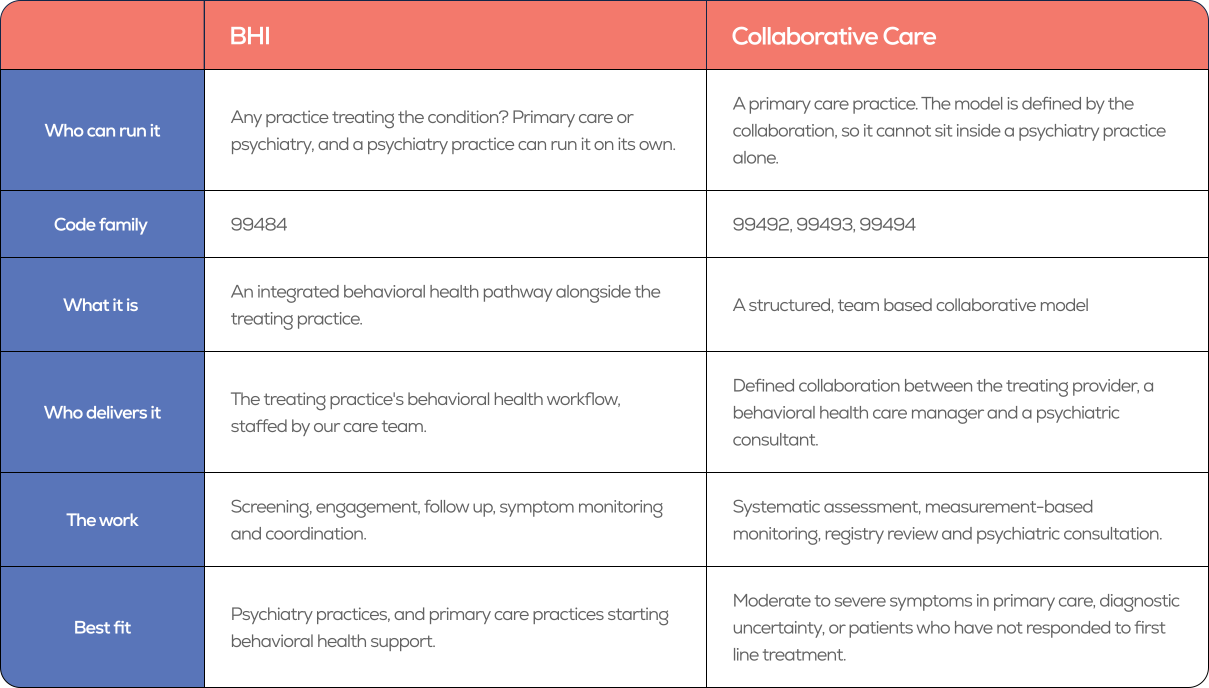
Both deliver behavioral health care under a structured program, and the two are routinely confused, including vendors selling them. The first difference is not clinical; it is structural: who is allowed to run each one. That decides the code of family, staffing, and whether the program is open to your practice at all.

If you are a psychiatry practice

BHI is your model, and it is a clean fit. The behavioral health code can be run by whichever practice is treating the condition, so you need no primary care partner and no collaborative team to stand up.

The work is screening, engagement, symptom tracking and coordination, delivered by our care managers under your direction, on patients you are already treating.

If you are a psychiatry practice

Both are open to you. BHI is the lighter start and the faster one to stand up. 
Collaborative care is the fuller model, built for patients whose symptoms are moderate to severe or who have not responded to first line treatment, because it brings psychiatric input to cases that would otherwise wait a referral month out. 

A practice can run BHI without standing up with a collaborative care team, and a psychiatry practice that is the model. Primary care practices frequently start with BHI and add collaborative care once the workflow is held.

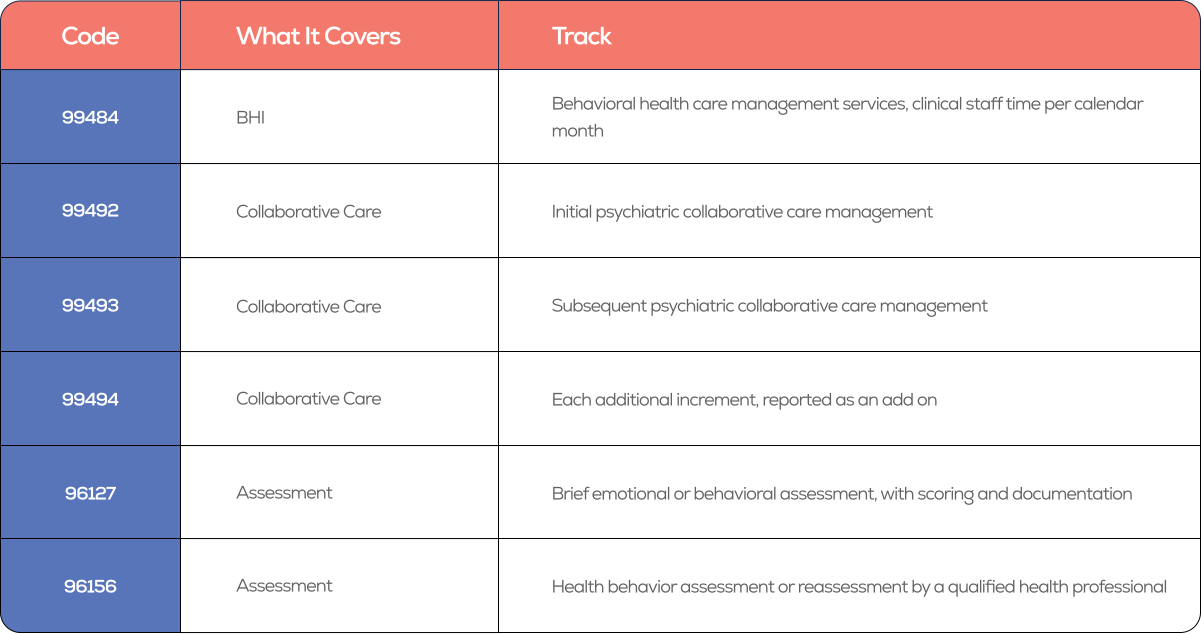
Full CPT Code Breakdown

Each code is defined by minutes of time per calendar month and by which member of the care team delivered it. CareNexa’s care managers log that time as the work happens rather than reconstructing it at month end. Your practice bills what was actually delivered, with the documentation and the measures already attached.

Reporting is subject to Medicare, Medicaid, commercial payer, scope of practice, documentation and coverage requirements. The codes above are examples and are validated for the specific payer and service before anything is billed. 

Patient eligibility

A behavioral health condition established by the treating clinician through clinical evaluation, where the patient needs more structured contact than the visit interval provides. There is no requirement for a second chronic condition. The setting decides the model rather than the eligibility, so the same patient may sit under BHI in a psychiatry practice or under collaborative care in a primary care one. 

Conditions that commonly qualify 

  1. Depression, including major depressive disorder and other depressive disorders.
  2. Anxiety, including generalized anxiety and panic symptoms.
  3. ADHD, in adults and adolescents under practice care.
  4. PTSD and trauma related symptoms.
  5. Bipolar and related disorders. 
  6. Adjustment and stress related disorders.
  7. Insomnia and other sleep related behavioral health concerns 
  8. Substance use disorders, including alcohol and opioid use, where clinically applicable

A screening score is not a diagnosis.

Diagnosis is established by the treating or otherwise qualified clinician based on clinical evaluation. Screening results identify who to look at more closely and give you a baseline to measure against. They do not establish a condition; they are never recorded as though they had, and no coordinator treats a score as a finding.

What is included:

  • Standardized screening and rescreening with validated instruments.
  • Practice branded patient outreach, engagement and follow up between visits. 
  • Symptom tracking with repeat measures and a maintained patient registry. 
  • Care plan creation and revision under provider oversight.
  • Psychiatric consultation input where the collaborative care model applies.
  • CPT qualification tracking and audit ready documentation.
  • Billing under the behavioral health and collaborative care codes.
  • Zero setup cost to the practice.

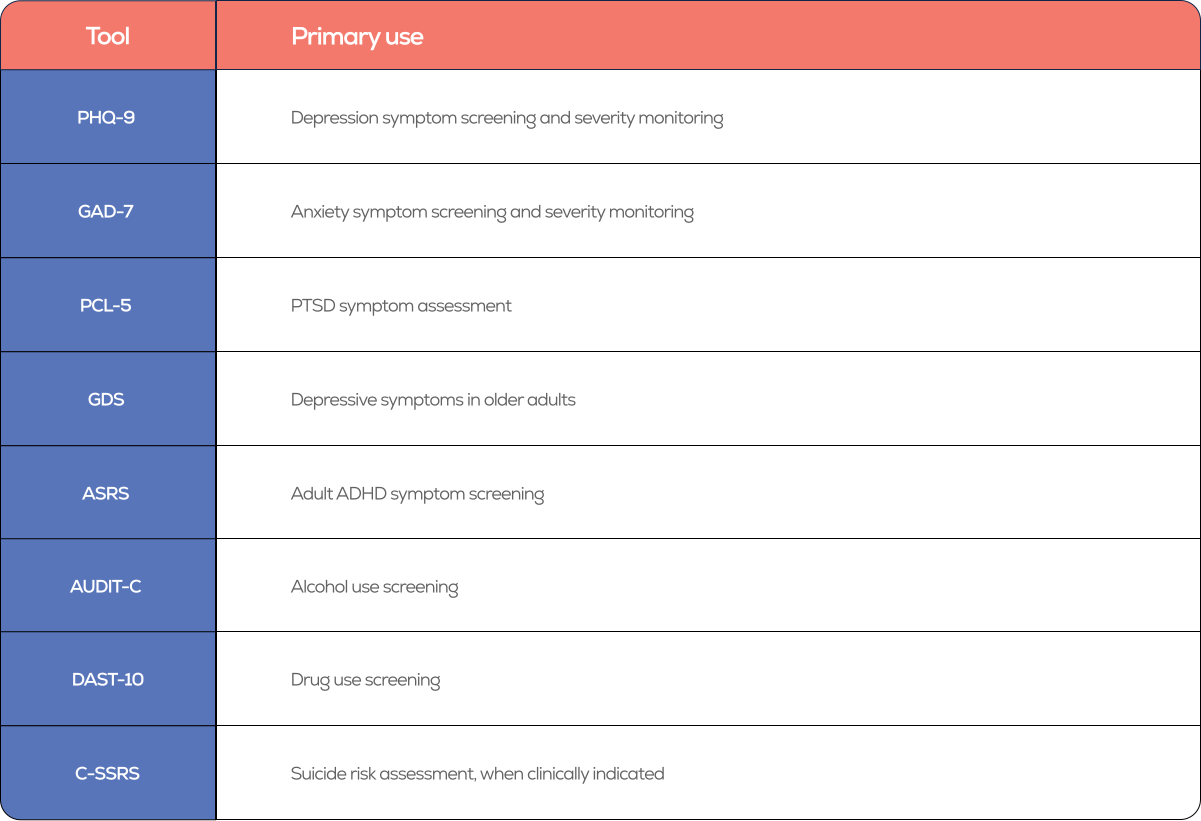
The Instruments We Screen and Measure With 

Measurement based care is the part of this that makes it work, and it only works if the same instrument is used at baseline and at every follow up. Scores are recorded against the care plan and travel back to you with the documentation. 

The last instrument on that list is handled differently from the rest. It is used when clinically indicated, never as a routine checklist item, and always under the escalation protocol set out below.

Sample Patient Journey — Month to Month

Enrollment is not the finish line; it is the start of a recurring monthly rhythm. Here is what a typical CareNexa behavioral health patient experiences from identification through ongoing care.

Month 0

Patient is identified through screening or clinician referral, contacted, and enrolled with documented consent. Baseline measures are recorded so that everything afterwards has something to be measured against.

Month 1

A care plan is created or supported under provider oversight, covering the treatment goal, the instrument being tracked and the follow up interval, then shared back to the practice. Under collaborative care, the case enters the registry, and the psychiatric consultant reviews it.

Months 2+

Structured follow up covers symptoms against the baseline score, medication response and tolerability, engagement and the practical barriers behind missed appointments. Repeat measures are recorded, the registry is reviewed, and time is logged and billed under the appropriate code.

As needed

Score deterioration, a safety concern, or a failure to respond is escalated to the treating clinician per the agreed protocol. Patients whose scores reach the treatment target are stepped down or graduated rather than kept enrolled because they are enrolled.

The Revenue Math, Shown Transparently

Enrolled Patients
Per month, low 
Per month, high
Per year, low
Per year, high
50
50 x low rate 
50 x high rate 
x 12 
x 12 
100
100 x low rate 
100 x high rate 
x 12 
x 12 
150
150 x low rate 
150 x high rate 
x 12 
x 12 

The number that bills 

Enrolled and sustained are different figures, and only the second produces revenue. Collaborative care carries something the other programs do not: it is designed to end. Patients who reach their treatment target graduate, which reduces this line and is the entire clinical point. Any model that assumes patients stay enrolled indefinitely is describing a program that is not working.

Behavioral Health Specific FAQ 

We are a psychiatry practice. Does any of these apply to us?

BHI does, and it is the cleaner fit. The behavioral health code is billed by whichever practice is treating the condition, so a psychiatry practice can run it without a primary care partner and without building a collaborative team. Collaborative care is the one you cannot run alone, because the model is defined by the collaboration between a treating provider, a care manager and a psychiatric consultant. If you want a route into that model, it runs from the primary care side with you as the consultant. 

The psychiatric consultant is a defined role in the model rather than a member of your staff, and the consultant reviews cases with the care team rather than seeing your patients. That is what makes the model workable for practices with no behavioral health hire and no realistic route to one. 

Risk screening runs under a protocol you approve before the program starts, and a care manager never holds a risk finding. A positive screen routes immediately to your designated clinician along the escalation path you defined, with the instrument, the score and the responses attached. Where a patient describes immediate danger, the protocol directs them to emergency services rather than to a follow up call. Nothing in this program puts a coordinator between a patient at risk and a clinician. 

Done correctly, structured behavioral health documentation is more defensible than informal follow up, because every billed minute is timestamped, tied to a coded activity and attached to a recorded measure. Measurement based care has an advantage here that the other programs do not: the scores themselves evidence that the work happened and that somebody acted on it. The failure mode CMS penalizes is under documented time, which is the specific thing this workflow prevents. 

Until the measure says they should not be. Collaborative care is built to treat to a target, so the expected path is improvement, step down and graduation rather than indefinite enrollment. Patients who are not responding are escalated for a treatment change rather than carried at the same intensity, which is the other thing a registry is for. 

Most of These Patients Are Already on Your CCM List 

In primary care, depression or anxiety alongside a physical chronic condition is the combination that most reliably undermines management of everything else, and where a patient is enrolled in both programs the time is tracked and billed separately through one clinical team and one dashboard. In psychiatry, BHI stands on its own and needs nothing alongside it.